Thursday, December 9, 2010
Batik fabric design!
Thursday, December 2, 2010
More updates...
We did Google sketch-ups, creating a building that has a columns. It was harder than I thought it was. But it was still fun. Those in graphic design have my utmost respect for the time and talent they put into their creations. Here's what my building looked like. The dome is a happy accident. Unfortunately, I struggled in trying to recreate it on the other side. So.. there's only a half dome. I don't know what this building would be used for, but I had fun creating it.
This assignment was done before our watercolor resist paintings. We were testing the elements (sorta). We would taste a piece of food and then with line, shape and color had to paint what it tasted like in a square that was sectioned off with tape (8 squares per page). We were experimenting with watercolor at the same time so we did different things like: wet-on-wet, wet-on-dry, use of different salts, use of saran wrap, and splattering. It was kind of fun. Can you guess what square is what food? You have the options of: sour patch watermelon, sour gummy worm, fudge brownie, muddy buddies, chicken in a biscuit cracker, chips & salsa, peanut butter & jelly sandwich, and chocolate chip cookie
Monday, November 29, 2010
Updating Assignments...
This is a watercolor resist. We used oil pastel to create an image of our window at nightfall, much like Van Gogh's Starry Starry Night. After applying the pastels, we'd then scratch out parts for texture and leave some areas blank for the watercolor. This view can be seen from my bedroom window. It's quite pretty. I chose bold colors to represent the storage units, the wild grass and the mountains.
Above are stamps we created using yarn and glue. It was extremely messy and unfortunately for me ended up not even working on my clay pots. What a bummer!
Using simple 'original' hieroglyphs, I created stamps that represented me:
(Left) paint brush on canvas, (right) musical symbol; almost like treble clef, (center) HaHa--I enjoy laughing
We used 'magic' clay. It smelled funny and didn't work very well for smoothing and blending your pot. There's a few designs in it too. I had fun playing with it, but it's not something I'd use with my students
Our pots are finished!
We got them back from the kiln.
After learning about archaeology and pottery of the ancients. We made our own. First testing it out with our 'magic' clay, making stamps and then putting it into context with real clay. My pots represent inner beauty. The music symbol is in one and the 'haha' one is in the other. Since the 'haha' is underneath those gem things that you find in grandma's house it has the symbolic inference that sometime you have to look under the facade or troubling moments to find the happier parts of life. It can represent people too in similar context. Some things that may appear broken (like the crack in the bottom) can in reality be quite beautiful if given the chance.
Scratchboard!
I truly felt like a kid when creating this one. Not only did black specimen get everywhere when you scratched it, but it was quite enjoyable to discover the bursts of color underneath the black tempera mixture. Plus the fancy, funky-dory letters and the texture create a very fun and creative design that sends you to the center of the page.
My statement for this one is as follows: Sometimes all we get to life or a problem are basic pieces of a puzzle, unsure as to how they fit together or lead to our main solution. If we look at them from a different angle, we can see the whole picture and truly get the answers that we're looking for.
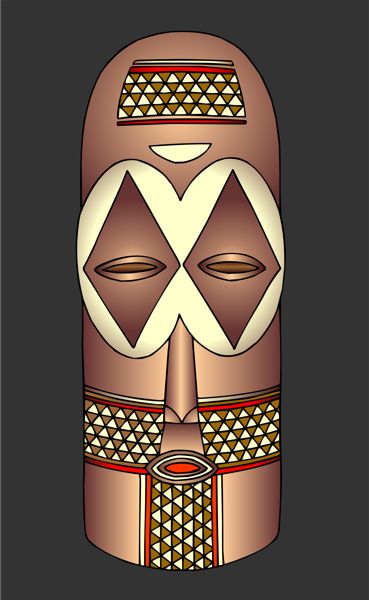
Well, above is my mimic African Mask.
It kind of reminds me of TRANSFORMERS for some reason.
Sometimes others may seem scary or intimidating. But you never know what you might find underneath if you just give them a chance. Everyday, people wear masks to hide, shade and create illusions of who they really are.
The trick with our sculptures, everyone was given a disability. I was and ESL student. Maele gave a few of us instructions in american sign language. It was confusing. The only words I got out of it was "cat", "painting" and "horse". So I made a cat pouncing on a mouse. The black thing in front is the mouse. You can kind of see the ears of the cat and his front paws from these two pictures. I randomly gave him a black tail, curvy back feet and a fat body.
It was a good experience. Those with disabilities have to work harder in a classroom to produce similar results as the other children without them. The question lies in how, as a teacher, you're going to accommodate your lesson for the students that need it.
Monday, November 15, 2010
African Masks
Although African Masks look really cool with their bold and abstract design, they were originally used as part of their ceremony costume. Different masks have different meanings. They were used for various ceremonies whether religious or social. Their masks represented the spirits of their ancestors uniting with the forces of nature in the community. When the mask was worn, it would come to life (kinda like the movie Mask with Jim Carrey) through the possession of the spirits in the performance of dance. A lot of the time the symbolism was related to nature or animals. This bond or relationship between man and the environment is highly valued in the African culture and has been represented throughout the ages of masks.


All of the masks would have symbolic meaning based on the design, line, color, texture and shapes
Thursday, November 4, 2010
Technology + Art Education = Benefits!!!
Technology has many possibilities or branches like Art. In my tech class last semester for my program, I learned about several ways to incorporate technology in my classroom. I'm sure that a lot of those ways could be reciprocated along with art education. Here are a few:
- Google Sketch-Up (as we learned in class)
- Blog
- Smart Board
- Photography
- Podcasts
- Video chat with modern artists
- Powerpoint (mini lesson, multiple examples of artwork
- Videos on famous artists (i.e. Van Gogh, Raphael, Picasso, Frida Kahlo, etc.)
- Internet Search (look for pictures to use in art assignments)
- Work alongside another teacher in a different city or state using video chat
- As a class, create a digital video that looks professional (http://www.olejarz.com/arted/digitalvideo/index.html)
As for being age-appropriate, you'd have to look at their motor skills involving the technology. For example, 1st and 2nd graders are just barely learning how to type and maneuver on a computer. Where as 4th and 5th graders understand computers enough to create a basic powerpoint presentation and write a letter. Whether or not it's age-appropriate depends on the lesson. What do you want them to do and learn? How much skill does it require?
In some ways it would be a lot easier to teach principles of design using technology. In other ways it'd be harder. Having the option of technological use in the classroom opens up several possibilities and directions that you could take your class. Using computers for instance can help teach about line, shape, color, scale, texturize, etc. just at a click of a button (our text book). Everyday we are becoming more and more of a push-button society. Why not use it to our advantage?
Friday, October 29, 2010
Age Appropriateness
This week we have to design or find an art lesson for a given age group and say why it's appropriate for that age group.
I found a lesson plan about Henry Rousseau and 'stained glass' windows. I tweaked it to meet the standards for the Utah State Core. This lesson plan is age appropriate because it matches up with the standards and objectives of the state core. It also uses the affective, cognitive and psychomotor skills developed at that age. They should be able to know how to use the oil pastels and the gel glue without making too much of a mess. I focused my lesson plan towards 4th graders. According to our textbook (p 210), 3rd-4th graders will typically:
- Create space and depth by employing vertical placement, diminishing size, and overlapping shapes
- Draw and compose with more conscious, deliberate planning and show more naturalistic/realistic proportions
- Mix and experiment with an expanded range of colors, including tints and shades
- Select and arrange objects to satisfy their compositional needs
If you want a copy, just email me and I'll send it to you. I was going to have a link or something on my blog, but I'm not sure how to make it work. :S sorry
Friday, October 22, 2010
Art or Craft?
As you may have guessed, our reflection is based off of the difference between arts and crafts since it is often confused by outside onlookers as the same thing. You'd probably hear comments such as: 'Why does art matter? Don't you guys just make mother's day gifts?' or 'Don't you just create tangible items in art? Like your pile of popsicle sticks, yarn and glue.'
Art is different than Crafts. At dictionary.com, I looked up art and craft. It said that art was defined as: Art (n) the quality, production, expression, or realm, according to aesthetic principles, of what is beautiful, appealing, or of more than ordinary significance. At the same place, craft was defined as: Crafts (as in arts & craft) (n) the handcrafting and decoration of esp. utilitarian objects. Art uses the principles and elements of design to create, where as crafts are more of creating decorations using tangible objects. In one article I found on suite101.com, a woman describes her theory in the difference between art and crafts: "Here's my theory: A craft is usually a cookie-cutter or close-ended activity. The craft activity is based on a formula or recipe and all participants follow the same directions and end up with roughly the same result every time. For example, creating a god's eye from two sticks and colored yarn is a great craft example. Yes, it involves creating something, but the end product is most always the same and there's not a lot of room for variation. While it may be possible to create a work of art in the cookie cutter style of a god’s eye, 99.9% of the time, the god’s eye will be a pleasing, colorful design, nothing more. This makes the god's eye project a craft.
Think about it. IF we teach that they are the same thing, how're they going to understand the art world later on in life? How're they going to know how to creatively think of solutions to problems? Or understand how/why form, line and color work together to produce something intrinsically beautiful and fascinating? In a book (Art, mind, and brain: a cognitive approach to creativity)by Howard Gardner, I read an excerpt that helps to bring across my point. He says: "In most areas of development, the formula is simple: Youngsters get better, more skilled, more sophisticated with age." (think of why it's better for youngsters to learn a different language when they are small vs when they're high school/college age) "...In some ways, young children are especially intimate with the arts, and the story of artistic development is replete with declines, zigs and zags, rather than following an upward progression. It is crucial to understand what is distinctive about artistic development and to consider its unusual trajectory may have implications for development writ large." Artistic development at a young age opens up neurological parts of the brain that decrease gray matter. Through the arts with observation and creativity, students learn to problem solve and think out of the box, they're able to grasp concepts a lot easier than with out the arts in their lives.
With this in mind, how're you to ever cognitively open children's minds with crafts (not much structure) only when it's more effective to teach the arts (lots of structure and concepts)?
Picture Posting Updates
We then had to use create a print using cut-out shapes of cardstock. The top is our crayon-rubbing print. And the bottom is our ink print
Friday, October 15, 2010
Motivation!
What motivates you as a learner? What do you think will motivate your future students?
For myself, I learn best when I have an interest in it. That goes for younsters too. If there's no interest, they're going to get bored and tune out (much like college students today when teachers drag their lectures on and on and on....). When I was younger, I remember my dad trying to teach my older brother countless times about the mechanics and necessary actions required for car care. My brother had no interest in it growing up. Now-a-days, he does cause he's married and sees how important it is. But he's still not very car smart. I'm sure if he would've paid attention or had interest in mechanics, he probably wouldn't have so many car problems. Influential educators of the past, such as William James and John Dewey, regarded interest as central to educational theory and practice. They examined and studied the psychology of education throughout their lives in the early 19th century. (http://www.aare.edu.au/99pap/pre99584.htm) Dewey said, "It is not enough to catch attention; it must be held". As teachers it's our job to focus on our students and meet their interests. Get to know them. Find out what they like and don't like. Use their interests as an advantage to teaching. We're all curious and social creatures, so it'd be a good idea to have creative, interesting lessons that will spark their interest.
And if what I'm learning matches up well with how I learn, which is mainly visually, I do better at absorbing the content. Experts say that there are several different kinds of learning, but the main 3 are: auditory (listening), visual (observing) and kinesthetic (doing). I think this is important when dealing with our students. Not every student is going to learn the same. Some will learn best through our lectures. Others will have to try it out themselves to learn it. I think it's best that we teach our lessons in such a way that they meet the needs in all three ways of learning. No one way of learning is better than another, either.
Now sometimes, we may not be able to find their interests or figure out their learning style. It'll happen, it's a part of life. In that case, we might have to think of other ideas to motivate our students. This website as several ideas of how to motivate students in your classroom: http://honolulu.hawaii.edu/intranet/committees/FacDevCom/guidebk/teachtip/motivate.htm
Thursday, October 7, 2010
Artist Statement
But also, we have a reflection as well.
Reflection: How to teach artist statements.
As educators, what's the best way to teach students the fundamentals of art in the simplest way possible? What's a good way to show them what an artist statement is and how it works with their artwork?
To start out, we need to tell our students what an artist statement is and how it is a valuable piece of our artwork. In my own words, an artist statement is a paragraph describing their art pieces and why they created it the way they did as well as how they created it. Ariane Goodwin said, "A good statement allows people who love your work to find out more about you, offers your audience more ways to connect with you, and increases their appreciation and perceived value of your work. Equally important, an artist statement gives you the opportunity to see what you do through the eyes of language, to validate your creations from a new perspective." You may have the sculpture or canvas in front of you, but without the artist statement, how can you really get to know the artist and their work?
I would try to explain to my class exactly what Ariane Goodwin portrayed, but on a simpler note (because of age and grade). They need to know what it is and how it applies to them with the class. I would also ask them questions about their work to help them form their artist statements. And then have them work on them on their own.
Another way to teach them is through a webquest like this http://www.suite101.com/content/scripting-an-artists-statement-a108847. A webquest is an online lesson/activity for your students. They can interact with peers, do projects, do assessments and online research as part of the lesson.
You could also use Art History as an example when teaching your class about them.
Artist Statements help explain the artwork and it's expression better than the just looking at the piece itself. It can explain how you created it, why you created it and the artist views about the meaning of the piece. In chapter 18 of our textbook, it talks about teaching art history to your students. If students know the era of art, it can help explain why the artist did what they did as well as explain different art aesthetics. This could be useful for teaching artist statements to your class. Although we may not particularly know what art era we are in today (I think it's contemporary, but I'm not sure), we can help our students to understand how to take their own culture and experiences using art history as an example. That way their artist statements have meaning with the depth of creation and context instead of being vague in explaining their art.
Sometimes, it's hard to think of what to write to describe your work. Which is why it would be a good idea to break it down simply for your students as you would break sentences down to understand it's different parts.
Saturday, October 2, 2010
More Postings...
I tried to convey simplicity through using simple objects from my room on the cream carpet of my living room.
I was studying at my friend's place and I just liked the form of lines from this view
I walked into my bathroom and really like the organic shapes as they fit with the hard straight lines of the counter and mirror. Again, it's aesthetic pleasure in the simplicity of contour line. Have you ever notice how many fluid lines are in a faucet? Try drawing one and see for yourself.
Friday, September 24, 2010
"Chinese" Calligraphy
I forgot to mention. We experimented with chinese brush painting and making our own name seals in "chinese" using dull pencils and small styrofoam squares. It was pretty fun. Here's what mine looked like. :)

Even my grasshopper. Can you find him?
With the use of line and value, I was able to portray a peaceful chinese art painting of bamboo. I wanted to express simplicity and aesthetic appeal with my format and content.

Do you see my name? I think one of the S's is backwards, but that's okay. It was kind of a challenge creating a name square with 7 letters, but I managed.
The assignment as a whole was not only fun but also not as time consuming as some of the other ones that we've done. Which is always a plus.
Assessment
Reflection: Find/create 6 assessment strategies in art education; 3 summative and 3 formative
Before I get to responding to the reflection question, I want to first spark some questions to spark some thinking. How do we assess students if everyone's artistic style is different? Are you assessing based off of following your instructions or copying your style as the teacher? What is the purpose of assessing and evaluating your students' artwork?
During my college experience, I’ve had two completely different painting teachers. The first one that I had was not quick to criticize your artwork unless you personally asked for it or his help. He would walk around the room and watch. He’d would give us instructions and examples of what and how we were going to paint that day. And then until the next assignment, you were free to do the assignment on your own, figuring it out for yourself. When he would aide you, he would explain and show on your artwork and then let you do it. I didn’t realize how grateful I was for his methods of teaching until I experienced my second painting instructor. The second one was very different. He’d explain and instruct how he wanted it done (which were also different methods) and then leave you to it. While walking around the room watching different students paint, he would stop and criticize either your method of painting or the painting itself. He’d give advice on how to do what he wanted. With a few struggling students who were quite new to the medium, he’d take their brush and do it for them. Throughout the semester, he tried to teach us how to paint using his impressionist style (total opposite of my own style). I’m very keen on detail, it’s how I paint and how I am. So naturally, throughout the semester my teacher and I butted heads but still gave each other respect.
I don’t know if his assessment was fair or not, but I managed to get an A (rare) out of his classe—I partially think part of it was due to talent and not progression or learning. So with this story in mind, where do you draw the line in assessment so that you don’t assess their style, but rather the product and progression of your students’ art experiences? Should teachers also assess themselves based off of their instruction and aide to their students? What is a good way to make sure that you’re not capping off their creativity by having them paint how you paint or draw like you draw with your personal style? As discussed in our textbook, ch. 5, how do you make sure that there is balance between completing the structured, sequential curriculum objectives while still keeping it open, creative and indeterminate?
Just something to think about.
So what is the purpose of assessing art? In the Art Education Assessment Framework, it describes the purpose for assessing art. It says that we assess our students artwork to help them understand the human significance of the 4 art forms: visual, music, dance and theatre through the discipline, joy and challenge. It also helps them to understand their lives through different experiences as it does with other frameworks such as science, math, english, etc.
Summative Assessment:
- Portfolios
- Discussions
- Journals
- Integrated performances
- Art shows with artist statements
- Self-Critiquing
- 2 min. buddy suggestions (students pair up, offer 1 thing they like about their neighbors artwork and 1 suggestion as to how to improve)
- Teacher moves about the room offering encouragement, asking questions and giving help to students as they work on assignments
- Use benchmarks with their assignments. As students reach each goal for their assignments, have them reflect on how well they are doing and if they would change anything in an open classroom discussion with everyone's artwork on the display. I wouldn't have any more than 1 or 2 benchmarks unless it's a big project
·
Thursday, September 16, 2010
Self portrait/Critiquing
As future teachers (mostly), we need to be able to teach our students how to critique art. There's 4 different things they need to do in order to critique art effectively and properly. They are describe, analyze, interpret, and judgement (http://oak.kcsd.k12.pa.us/~projects/critic/; lecture in class). Through this process, students can learn ways to look at and describe art in ways they never have before. To really get the meaning behind it or to spark interest in a particular artist or artwork. I would hope to use this process in my classroom as I teach them about the arts. I'd also give them art terms so they could use them to appropriately critique art in class.
When having students critique each other's artwork, it can be a bit of a challenge. They might not know what to say to fully express themselves or they might say silly things to get the class to laugh. You can't be too derogatory with them either or they'll get upset by your comments--more the students words than the teacher's. The best way to have them critique their artwork is to keep it simple and positive. Ask unbiased questions. Offer supportive prompts. One teacher had this happen to her and had a few good ideas for helping students critique their artwork and their peers' artwork. She asked one of her students "what is your painting about?". The girl responded and then the teacher asked the class audience what they liked about her artwork. By the raise of a couple hands only a few were willing to respond. The teacher told the girl that she got to pick who got to speak. Gradually the whole class was raising their hands to respond. It helped the girl feel good about what she did as well as helping the students pay more attention to what they liked about their peer's painting. (The elementary critique: talking about children's art, Shirley Ende-Saxe.) I thought that this was a very good way to go about it, especially since it includes all four parts of the process at the same time. Students are saying what they like about it (judgement) and why (describe, analyze, or interpret).
I think as we introduce the principles of art and elements of design to our students, they will be able to get a better sense of what they are looking at. So that they understand them better, you could show them famous pieces or artwork and ask the class to tell you ways that the painting portrays it. Then when it comes their turn to create a work of art, you could ask them what they noticed about the artwork that everyone created. "Students always learn from seeing how someone else completed the same task."----Mrs. Baker, Highland Elementary School website. You could do this for all grades, but as you get into the older grades, expect more of an 'in-depth' answer than that of lower grades. (I'd do this because the lower grades aren't going to understand everything as much as the upper grades, so you'd have to keep it simple.) I'd also eliminate any negative feedback from peers--no kid wants to know they didn't do well or that they aren't liked by someone in the room. One way to do that is to ask the students if they themselves want to change anything or ask what they felt their strongest points of the piece are (lecture in class). Ask them questions in relation to the elements and principles of design about what they notice.
In addition to my reflection... I'm posting what we've recently done in class. We recently learned how important it was to look at something while drawing instead of pulling it out of your head. If you're looking at something, you can have things be more proportionate and fluid on your paper or canvas than if you went off of memory. We were asked to draw ourselves first from memory, second by looking at a photo and third by using a 8x10 graph.
With this set, I wanted to express how important it is to draw for sight as well as measurement. Through the first draft, we had to go off of memory. The second we could look at our photo, but I didn't measure it too well. The final attempt, we used a graph and had to shade based on the values we saw in the photo.
Tuesday, September 14, 2010
Blah and Postings
So... to be short and simple. We have to post our ''Picasso" heads and our designs for it. Have a gander. :)
I wanted to express the different textures you could use with design and color using blind contour line of my classmate
Through this I wanted to try out different designs to put toward my final piece of mark
Friday, September 10, 2010
Art is SO important.
As for the reflection: Why is it important to teach art?
I feel it is important to teach art as much as it is important to have sports and music in schools. Art gives students culture and enhances their mind, encouraging them to be there own person. Everyone views the world differently and needs to express themselves in various ways. Children need to know how to express what they see, feel, etc. One of the greatest ways to do that is through art. 'Art has unquestioned merit as a unique avenue to cognitive, social and individual growth.'---Emphasis Art, p 9.
I wrote a paper once on how politicians need to keep the arts in school because it's academically better for children. Those that participated in some form of art whether they did music, dance or visual arts, scored better on standardized tests than those that did not participate in those activities. Take this paragraph written by the Secretary of the U.S. Dept of Education, she says
Art education helps students know how to express visualization and understanding in other areas like science, literature, math, etc. It demonstrates several relationships in various subjects of life and exemplifies the opportunity of choice. (Creation of Mind, ch 4) It allows students to think outside of the box to solve problems. 'Art education promotes higher thought processes, such as a willingness to imagine possibilities.... and an ability to recognize multiple perspectives. ...Students can acquire a feel for what it means to transform their ideas, images and feelings into art form.'---Emphasis Art, p 5.
So... basically... Art is just that awesome that it SHOULD and NEEDS to be taught to youngsters. It's not only my opinion, but it's beneficial in more ways than one.